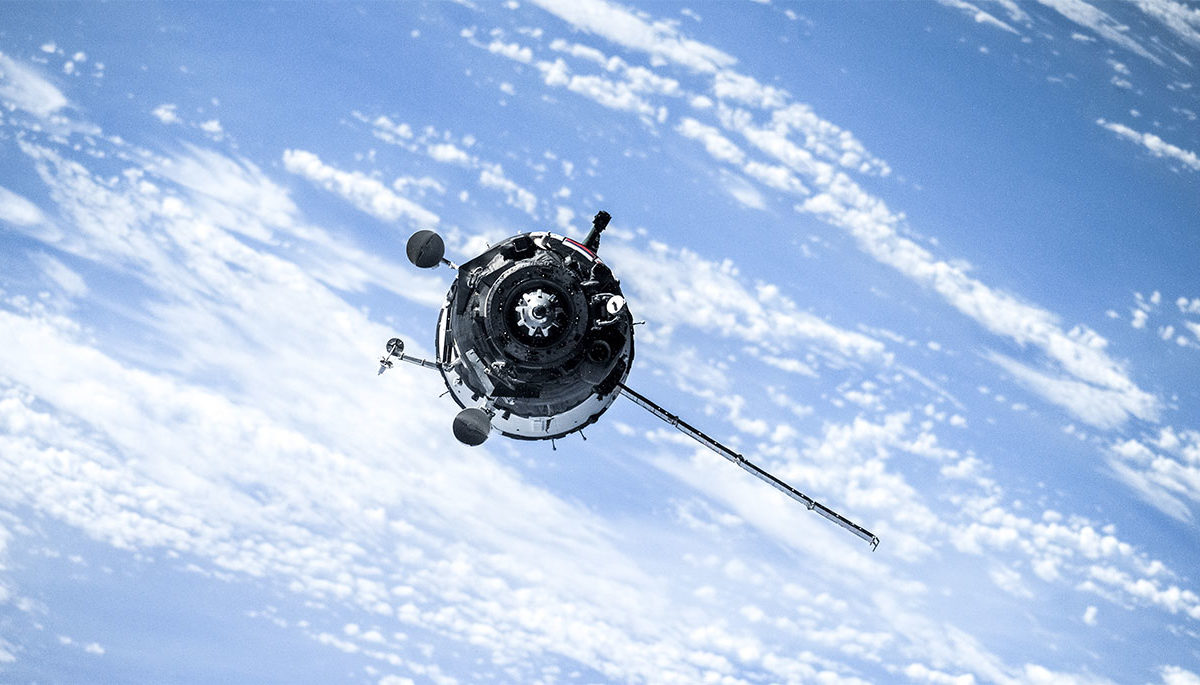
In modern Optical Inter-Satellite Links (O-ISL), stable, high-speed communication between satellites is enabled by laser technology. This application demands motion systems with ultimate precision and dynamic response to maintain a flawless laser link across vast distances—a requirement perfectly met by piezosystem jena’s technology.
Our systems are critical for:
- Active Vibration Damping: Counteracting platform disturbances and vehicle vibrations that could cause beam jitters.
- Fine Steering and Alignment: Continuously correcting the beam path to compensate for minor misalignments.
- High-Speed Adjustment: Ensuring rapid compensation to maintain link quality at gigabit speeds.
Piezo Solutions for Aerospace Data Communication Applications

In general, piezo based FSMs are ideal for use in space environments due to a number of inherent technology benefits. Piezo solutions offer:
- Instantaneous Response Times
- No Electromagnetic Interference
- Low Power Consumption
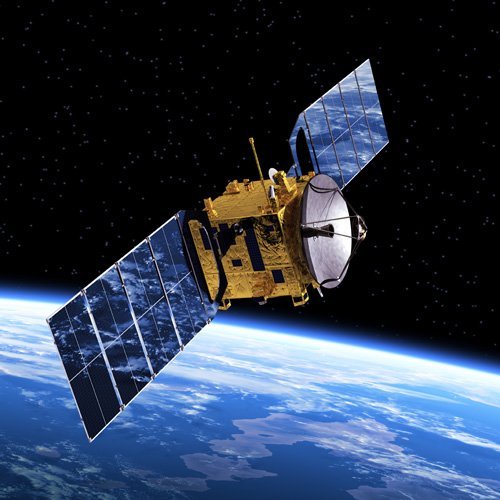
Satellites with fast steering tip-tilt mirrors for directing laser communications are being designed now for launch over the next few years.
Over the past ten years, piezosystem jena has developed an extensive product line of FSMs. Our FSMs are designed to provide the following benefits for use as Fine Steering Mirrors and Point Ahead Mirrors in optical terminals:
- High Displacements – for faster pointing, acquisition, and tracking.
- High Stiffness – to increase the achievable bandwidth with large mirrors.
- Smart Flex-Hinge Designs – for friction and stiction free operation without mechanical wear, thus improving reliability.
- Small Form Factors – to allow for easier terminal integration and cheaper payload launch costs.
Our FSMs:
- Displacements up to ±20 mrad.
- Sub-microradian resolutions.
- Closed-loop strain gauge feedback for elimination of hysteresis and drift.
- Bandwidths up to 6500 Hz.
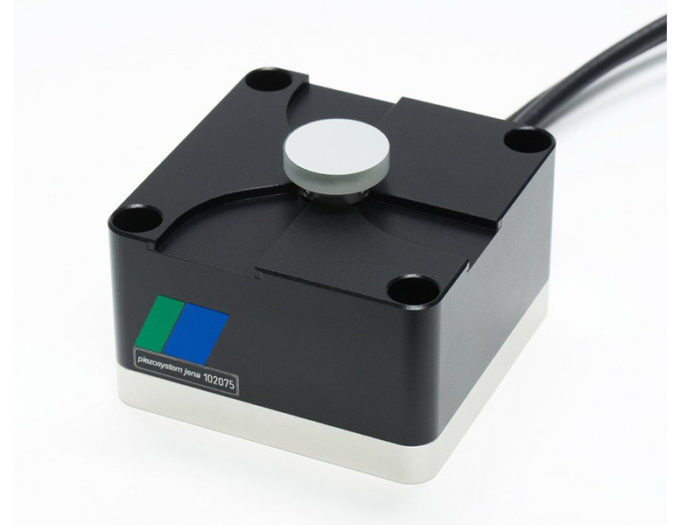
Space Qualified – Developed by European Space Agency
Why Our Technology Was Tested for Space
Despite preliminary suitability, the systems still lacked the rigorous proof of suitability for all space applications required for flight. The space qualification test by ESA was necessary to design and validate a system capable of handling the dual, complex requirements of O-ISL and possessing superior robustness to withstand shock and vibration loads during launch over a wide temperature range.
How We Passed the Test
Our latest series of PSH series (PSH 20/2 and PSH 35/2) were initially developed for European Space Agency (ESA) as the SQATTS (Space Qualified Tilting System) project. The technology phase was successfully completed, providing proof of the targeted specifications based on the engineering models that were set up, and confirming system readiness.
This validation confirmed our systems for the critical, dual functions of:
- Fine Steering Mirrors (FSM): Compensating for external disturbances and atmospheric aberrations in real-time.
- Point-Ahead Mechanisms (PAM): Creating a precise offset angle between the transmitted and received laser beams to account for the satellite’s movement during the light’s time of flight.
Our PSH design provides one solution for both FSM and PAM applications, resulting in a significant reduction in integration effort and costs for optical systems.

Key Features of our Space Qualified PSH Series
Our space-qualified PSH 20/2 and PSH 35/2 design offers major advantages for O-ISL applications:
- Unrivaled Precision: As solid-state devices, piezo actuators offer virtually unlimited positioning resolution and zero mechanical play, which guarantee the highest pointing accuracy.
- Robust and Reliable: The systems feature high robustness to withstand the extreme shock and vibration loads during launch, a wide operating temperature range, and an outstanding lifetime.
- Energy Efficient: Due to their capacitive nature, our piezo actuators consume no electrical power while holding a position, making them ideal for power-constrained satellite platforms.
This project together with ESA confirms that our PSH systems meet the most stringent criteria for space qualification, making them the superior choice for not only O-ISL but also other critical lab and production environments, such as those found in advanced semiconductor manufacturing tools.